
Choosing between Remy hair vs non-Remy hair is one of the most important decisions you’ll make before buying hair extensions, yet it’s also one of the most misunderstood. Both terms appear constantly in product listings, but very few buyers actually understand what separates them — or why the difference can mean the gap between extensions that last a year and ones that fall apart within weeks.
What Is Remy Hair?
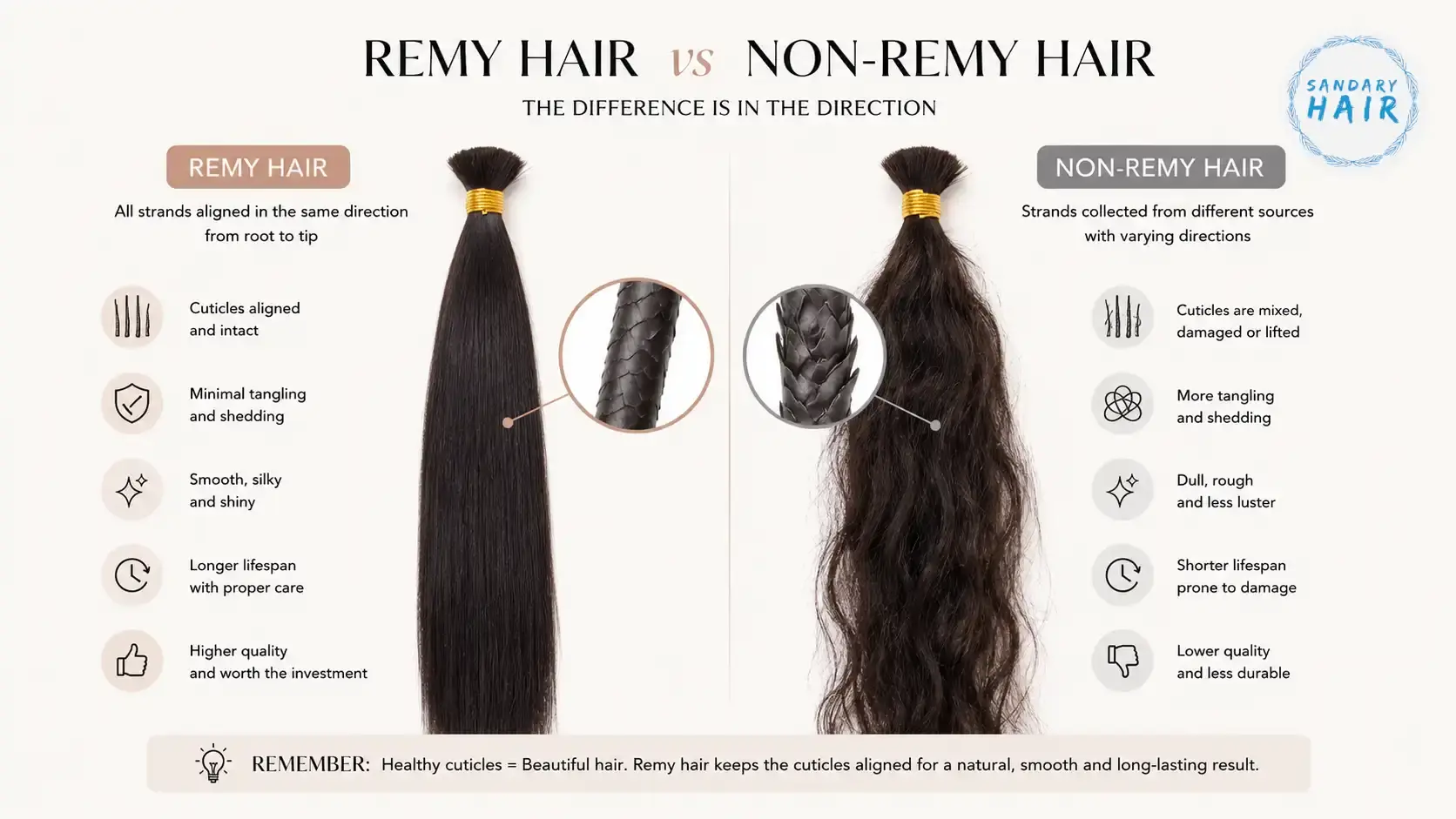
Remy hair refers to human hair that has been collected in a way that preserves the natural direction of the hair cuticle — the outer, protective layer of each strand. In genuine Remy hair, every strand is kept aligned from root to tip, exactly as it grew on the donor’s head, rather than being mixed together randomly during collection.
This alignment matters because the cuticle functions like tiny overlapping scales, similar to shingles on a roof. When all the scales face the same direction, hair strands glide smoothly against one another, resulting in a silky texture, natural shine, and strong resistance to tangling.
What Is Non-Remy Hair?
Non-Remy hair, by contrast, is typically gathered from mixed sources — often collected from hairbrushes, salon floor sweepings, or unsorted donor batches. Because strands come from different directions and are bundled together without alignment, the cuticles clash against each other, causing tangling and matting almost immediately.
To make non-Remy hair sellable, manufacturers often strip away the cuticle layer completely using an acid bath, then apply a silicone coating to artificially restore shine and softness. This coating looks convincing in the packaging, but it washes away after just a few uses — revealing the rough, damaged structure underneath.
Remy Hair vs Non-Remy Hair: Key Differences at a Glance
| Feature | Remy Hair | Non-Remy Hair |
|---|---|---|
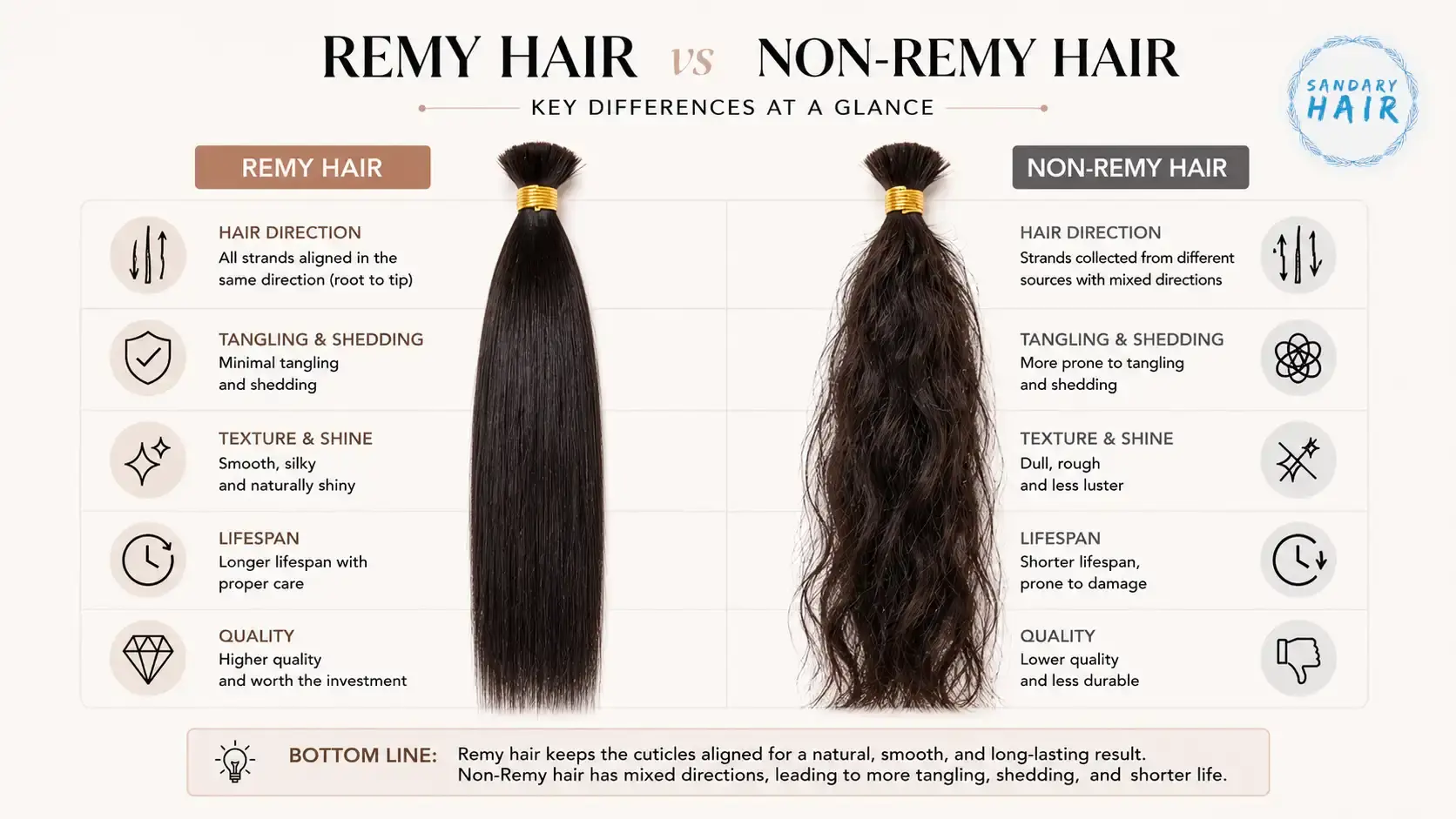
| Cuticle Direction | Aligned (root to tip) | Mixed/random |
| Texture After Multiple Washes | Stays soft and smooth | Becomes dry and rough once silicone washes off |
| Tangling | Minimal | Frequent, especially at the nape |
| Average Lifespan | 6–12+ months with care | A few weeks to 2 months |
| Styling Versatility | Can be dyed, curled, straightened repeatedly | Limited due to weakened hair structure |
| Price | Higher upfront cost | Lower upfront cost |
Why Non-Remy Hair Feels Great in the Store but Fails Later
This is the most common complaint among first-time buyers: the hair felt silky and shiny at the time of purchase, but after just two or three washes, it became dry, dull, and impossible to detangle. This happens because the silicone coating applied to non-Remy hair isn’t permanent — it’s designed to wash away gradually, exposing the cuticle-free structure underneath that can no longer hold moisture or shine on its own.
How to Tell Remy Hair From Non-Remy Hair
There’s a simple physical test you can do yourself: run your fingers along a hair strand from the tip toward the root. Genuine Remy hair will feel smooth in this direction because the cuticles are aligned consistently. Non-Remy hair, on the other hand, will feel rough, catch on your fingers, or begin to tangle almost instantly.
Beyond the touch test, reputable suppliers — especially those sourcing directly from Vietnamese hair factories — can provide documentation and traceability proving the hair’s Remy status, along with samples available for testing before a bulk purchase.
Remy Hair vs Non-Remy Hair: Why It Matters for Salons and Resellers
For salon owners, stylists, and hair business owners, the quality of hair sold directly determines whether a client returns for a second purchase or leaves a negative review. Clients who experience shedding, matting, or dullness within weeks of installation are unlikely to trust the brand again, regardless of how attractively the product was marketed.
Building a business around genuine Remy or Virgin Vietnamese hair creates a foundation of trust and repeat customers, which is far more valuable long-term than competing purely on the lowest price point.
Frequently Asked Questions
Is Remy hair the same as Virgin hair?
No. Remy refers specifically to cuticle alignment, while Virgin refers to hair that has never been chemically processed. The highest quality extensions combine both — Virgin Remy hair — offering natural strength alongside a smooth, tangle-resistant texture.
Can non-Remy hair be salvaged with better care?
Careful washing and deep conditioning can slow down the deterioration of non-Remy hair, but they cannot restore the missing cuticle layer. Once the silicone coating wears off, the underlying structural issues remain.
Is Remy hair worth the higher price?
For most buyers, yes. While the upfront cost is higher, Remy hair’s extended lifespan and reduced need for replacement typically make it more cost-effective over time, especially for regular wearers or resellers.
Conclusion: Remy Hair vs Non-Remy Hair
When it comes down to Remy hair vs non-Remy hair, the real difference isn’t visible on day one — it shows up weeks later in tangling, shedding, and disappointment. Genuine Remy hair offers better texture, longer wear, and far greater overall satisfaction for both individual buyers and wholesale customers alike. Browse our Remy hair extension collection to experience the difference for yourself.