
Understanding raw hair vs processed hair is one of the most important steps before buying hair extensions, yet it’s a distinction that’s often confused with other terms like Remy or virgin hair. While related, “raw” and “processed” specifically describe how much manufacturing intervention the hair has gone through after collection — and this directly affects texture, durability, and price. This guide breaks down exactly what separates the two, along with practical ways to identify genuine raw hair before you buy.
What Is Raw Hair?
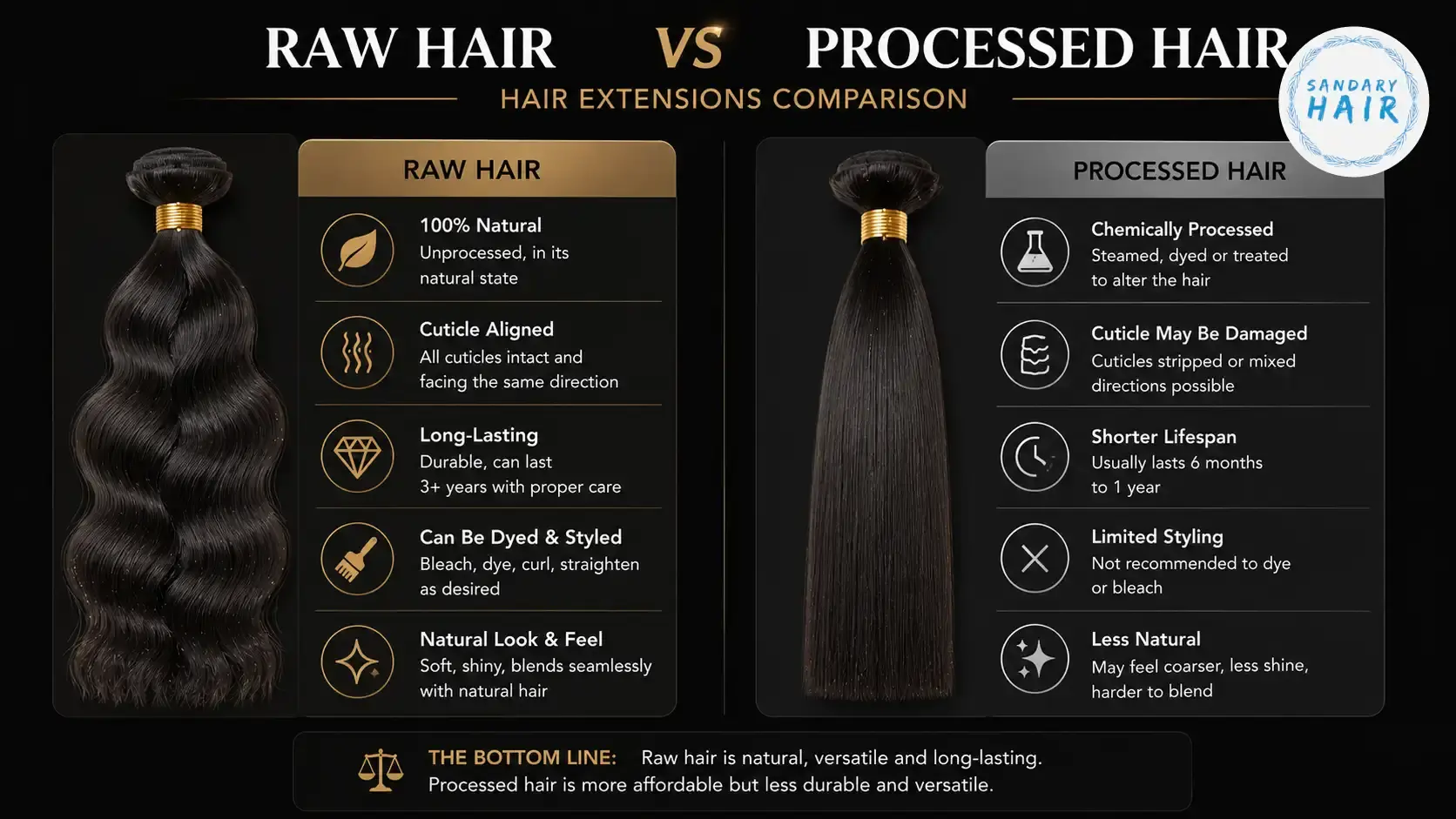
Raw hair refers to human hair collected directly from a single donor in its most natural state, with little to no manufacturing intervention. The cuticles remain fully intact and aligned, and the hair hasn’t been bleached, acid-washed, silicone-coated, or chemically altered in any way. Raw hair is essentially the purest form of human hair extensions available, closely tied to the concept of Virgin Vietnamese hair, though “raw” specifically emphasizes minimal manufacturing steps rather than the absence of chemical history alone.
What Is Processed Hair?
Processed hair has undergone one or more manufacturing steps designed to make mixed or lower-quality hair batches look more uniform and appealing. Common processing methods include acid baths to strip the cuticle layer, silicone coatings to add artificial shine, and steam treatments to create uniform wave or curl patterns that don’t occur naturally. While processed hair can look attractive on the shelf, these treatments are typically temporary and mask underlying quality issues rather than fixing them — a pattern closely related to what happens with non-Remy hair.
Raw Hair vs Processed Hair: Pros and Cons
Pros of Raw Hair
- Retains natural cuticle alignment, resulting in smooth, tangle-resistant texture
- Can be dyed, bleached, or permed by the end user since it hasn’t been chemically altered beforehand
- Offers the longest usable lifespan among all hair types, often exceeding a year with proper care
- Ages naturally and gracefully, without sudden texture changes once washed
Cons of Raw Hair
- Higher upfront cost due to careful sourcing and minimal processing
- Natural variation between bundles, since it isn’t artificially uniformed
- Requires trusted, verified suppliers to guarantee authenticity
Pros of Processed Hair
- Lower upfront price point
- More uniform appearance across bundles due to standardized treatment
- Wider variety of pre-set textures (curly, wavy, etc.) without additional styling
Cons of Processed Hair
- Shorter lifespan, often just a few weeks to a couple of months
- Coating wears off over time, revealing dry, rough texture underneath
- Cannot be re-dyed or lightened reliably due to prior chemical treatment
- More prone to tangling and shedding with regular washing
Raw Hair vs Processed Hair: Side-by-Side Comparison
| Feature | Raw Hair | Processed Hair |
|---|---|---|
| Cuticle Condition | Fully intact, aligned | Often stripped or damaged |
| Chemical Treatment | None or minimal | Acid-washed, silicone-coated, or steam-treated |
| Colorability | Excellent, can be dyed freely | Limited, may react unpredictably |
| Lifespan | 12+ months with care | A few weeks to 2 months |
| Price | Higher | Lower |
| Texture Consistency | Natural variation between bundles | Artificially uniform |
How to Tell Raw Hair From Processed Hair
A simple burn test can reveal a lot: genuine human hair, whether raw or processed, will smell like burning protein and curl away from the flame rather than melting like plastic, which helps rule out synthetic blends. To specifically identify raw hair, try the same finger-glide test used to check for Remy hair: run your fingers from tip to root — raw hair will feel smooth and consistent, while processed hair may feel slightly coated or overly slick from silicone treatment.
Another reliable test is coloring a small sample strand. Raw hair will absorb and hold color evenly, similar to how your own natural hair reacts, while processed hair often takes color unevenly or reacts with unexpected brassiness due to prior chemical treatment. Reputable suppliers sourcing from a verified Vietnamese hair factory can also provide documentation and sample bundles to confirm authenticity before a bulk order.
Does Raw Hair Mean the Same as Single or Double Drawn?
No — raw vs processed describes the chemical and manufacturing history of the hair, while single drawn vs double drawn describes how strands are sorted by length. You can find raw hair in either single or double drawn form, so these are two completely separate decisions to make when choosing your extensions.
Why This Matters for Longevity and Value
As covered in our guide on how long hair extensions last, hair quality is the single biggest factor determining lifespan. Raw hair consistently outperforms processed hair in this regard, making it a smarter long-term investment despite the higher upfront cost — particularly for anyone wearing extensions regularly or running a wholesale hair extensions business where repeat customer trust depends on consistent quality.
Frequently Asked Questions
Is raw hair the same as virgin hair?
They’re closely related but not identical. Virgin hair specifically means the hair has never been chemically treated, while raw hair emphasizes minimal manufacturing intervention overall. In practice, most raw hair is also virgin hair, especially when sourced from a single donor with full traceability.
Can processed hair be restored to raw quality?
No. Once hair has been acid-washed or chemically treated, the original cuticle structure cannot be restored. Deep conditioning can temporarily improve texture, but it won’t reverse the underlying damage caused by processing.
Why does raw hair cost more than processed hair?
Raw hair requires careful, ethical sourcing from a single donor along with strict quality control to avoid mixing batches, which increases both labor and sourcing costs compared to mass-processed hair collected from mixed, unverified sources.
Conclusion
When it comes to raw hair vs processed hair, the difference goes far beyond price — it determines how long your extensions will last, how they’ll respond to styling, and how natural they’ll look over time. For anyone seeking long-term value and styling versatility, raw hair remains the superior choice. Explore our collection of raw Vietnamese hair extensions to experience the difference for yourself.